During Child Protection Week, our educators and children came together to explore what it means to feel safe, be heard, valued and included at Lakeview Pre-School.
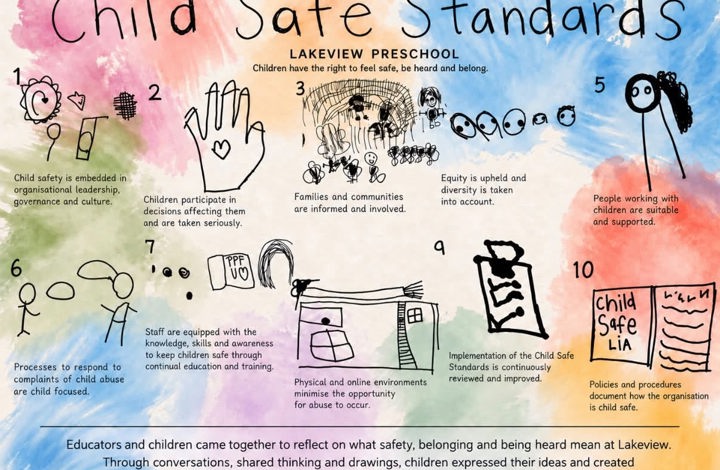
Through conversations, shared thinking and drawing, children explored the Child Safe Standards and shared their own understandings of safety, belonging, inclusion, trusted adults and having a voice in the things that affect them.
The children’s original drawings were intentionally retained in our final representation of the Child Safe Standards. We recognise children as capable contributors, and drawing is one of the many ways young children communicate their ideas, experiences and understanding of the world around them.
By listening carefully to children and making their thinking visible, their voices became an important part of how we represent child safety at Lakeview.
Our learning during Child Protection Week reflects our ongoing commitment to ensuring children’s rights, voices and safety are embedded in everyday practice — not simply discussed during one week of the year.
This work connects with the Child Safe Standards, Early Years Learning Framework V2.0, National Quality Standard and the United Nations Convention on the Rights of the Child, supporting our belief that every child has the right to feel safe, be heard and belong.
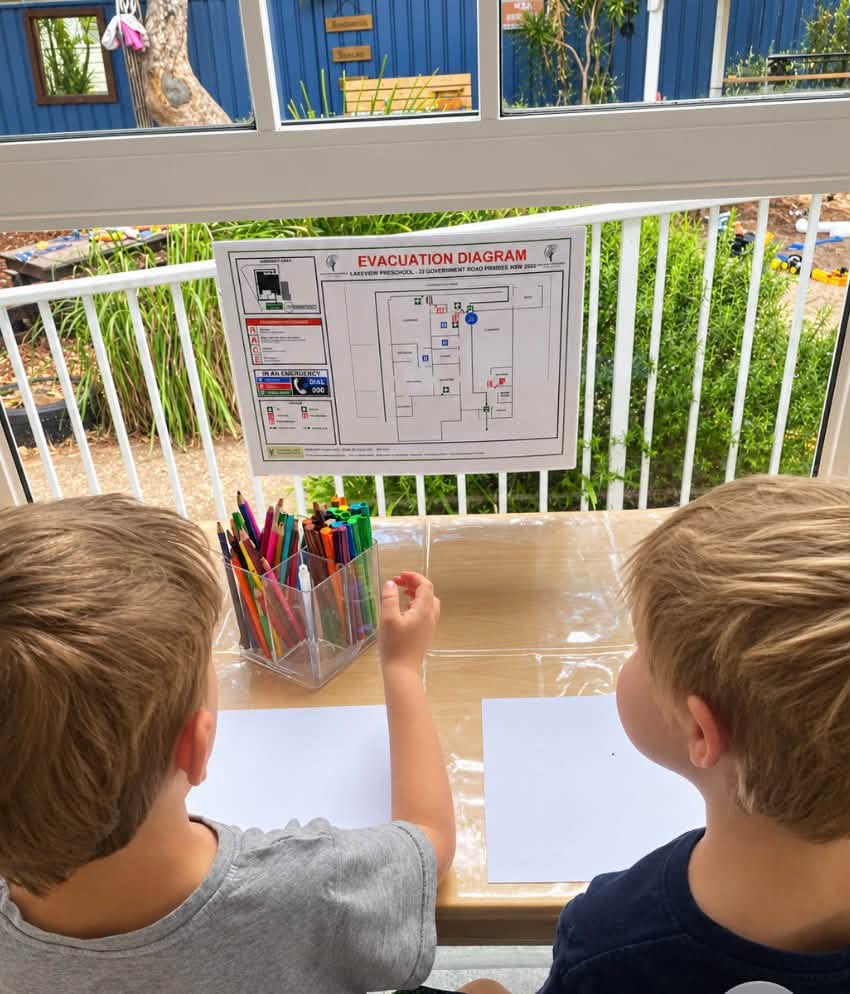
Fire safety at Lakeview is more than a one-off experience. Through our regular evacuation and lockdown drills, children are active participants in learning what to do in an emergency, who our safe adults are, why we listen carefully, and how we can help keep ourselves and others safe.
Children are also encouraged to reflect on and evaluate our emergency drills. Following an evacuation or lockdown practice, we talk together about what happened, what went well and what we could do differently next time. Through our Children’s Council, group discussions, drawings and other learning experiences, children share their thoughts about evacuation routes, meeting points, listening to educators and keeping themselves and others safe. Their ideas and observations are valued as part of our ongoing reflection and help us continually strengthen our emergency practices.
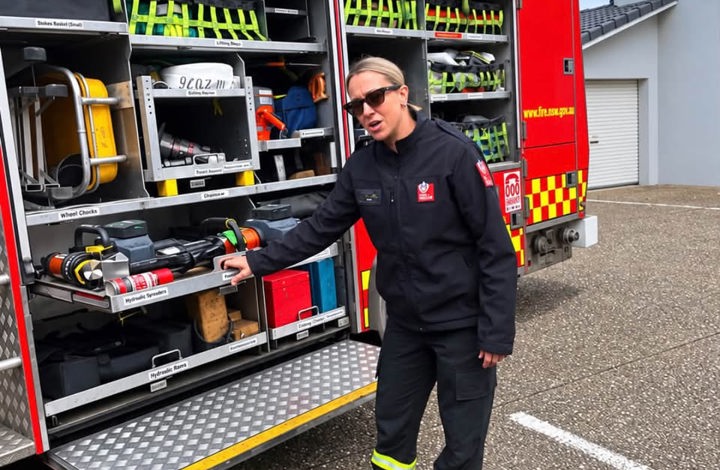
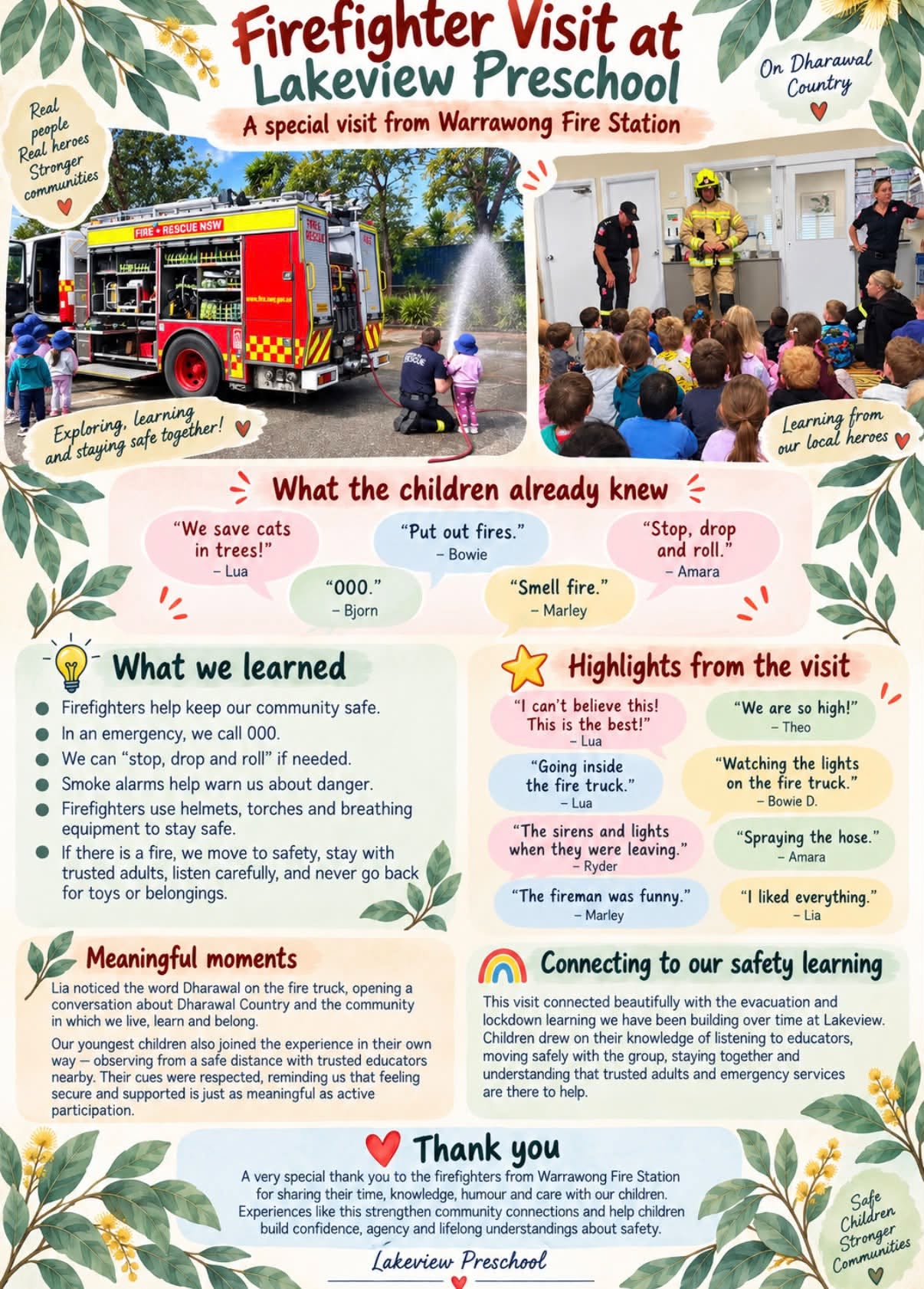
Our recent visit from the local Fire and Rescue brigade brought this learning to life. Children explored the fire truck and equipment, practised important fire-safety messages and confidently shared what they already knew from our emergency drills and ongoing discussions.
These meaningful community partnerships help children build confidence, strengthen their understanding of safety and develop connections with the people who help care for and protect our community.
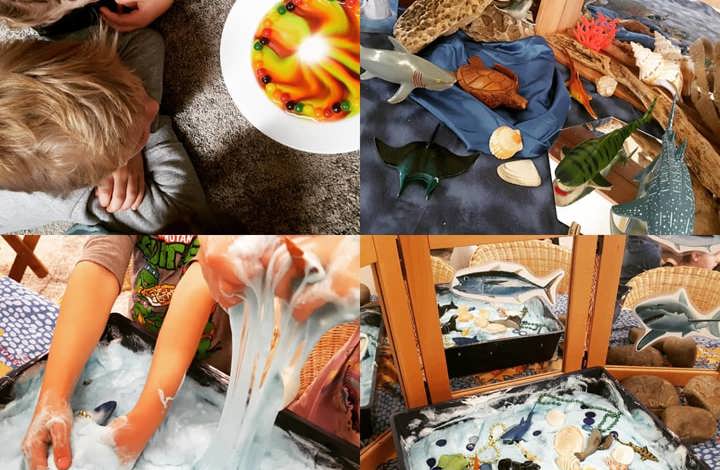
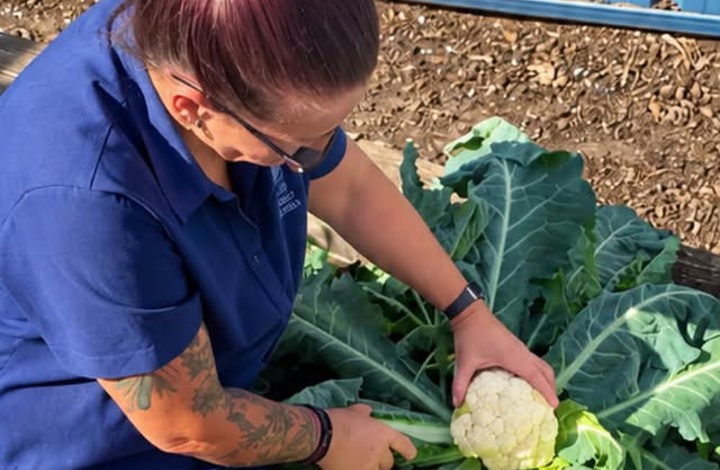
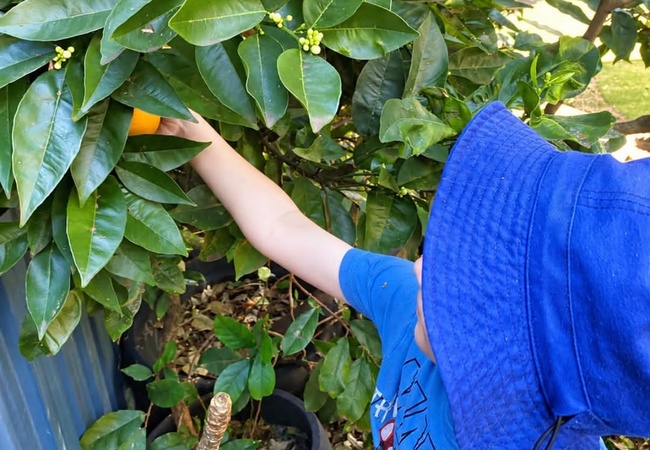
Our herb, bush tucker and vegetable gardens provide fresh, seasonal food all year round. Children help plant, care for, harvest, cook and taste what we grow, supporting healthy eating, wellbeing, sustainability and a meaningful connection from garden to table.
The children are involved throughout the process — from tending and watering plants to discovering when produce is ready to harvest. These hands-on experiences give children a real understanding of where food comes from and how it grows.
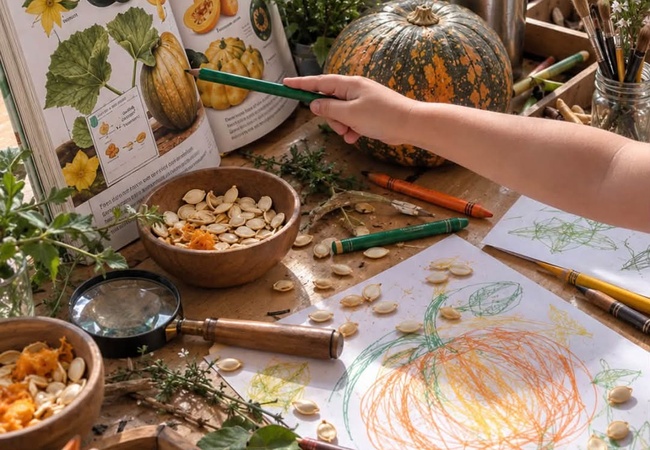
Harvesting also creates wonderful opportunities for investigation. Children can look closely, touch, smell and taste what they have grown, noticing colours, textures, seeds, shapes and changes in the produce.
The learning then continues from the garden into our cooking experiences, where children can help prepare and taste the food they have helped grow. It creates a meaningful connection between caring for the garden and the food we eat.
These everyday experiences support healthy eating, sustainability, responsibility and respect for the natural environment — while giving children the satisfaction of seeing something they have helped nurture become part of their day at Lakeview.
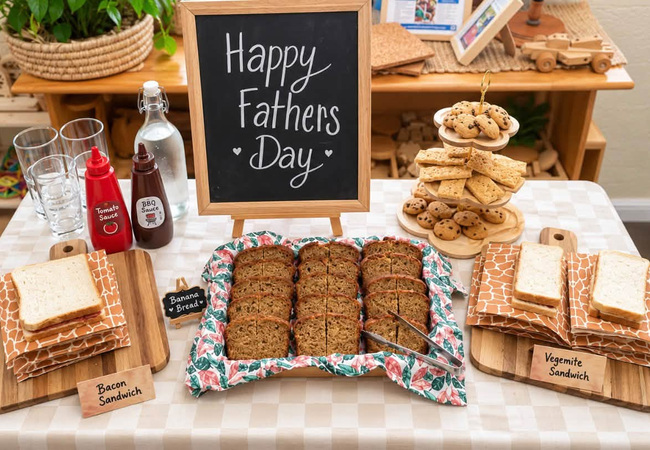
Father’s Day at Lakeview is a special opportunity to celebrate the dads, grandfathers and special people who play an important role in our children’s lives.
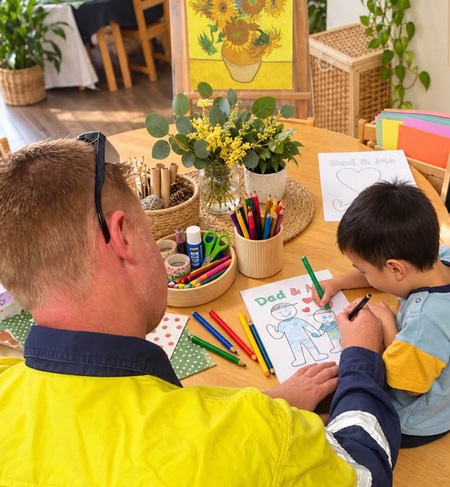
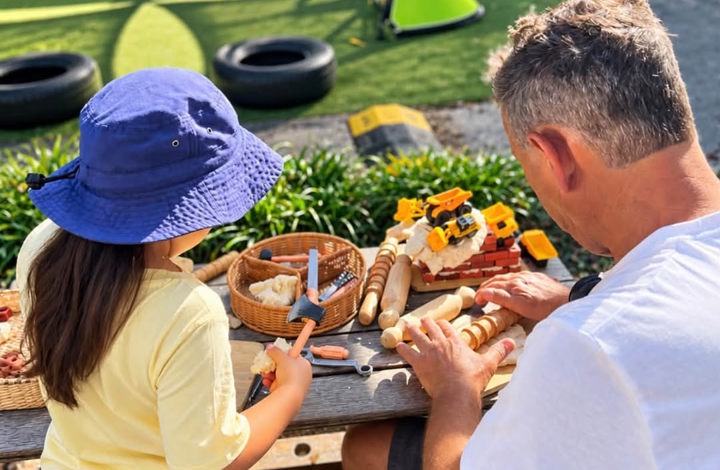
This year we loved welcoming our families into Lakeview to spend time alongside the children in their preschool environment. Rather than simply watching, our visitors became part of the children’s play and learning — building with playdough and construction materials, kicking balls, exploring the garden and sharing activities together.
For the children, there is something very special about inviting the important people in their lives into their world. They were excited to show them where they play, what they enjoy doing and the experiences that are part of their days at Lakeview.
Our Father’s Day celebration also provided opportunities to strengthen the connection between home, family and preschool. Children shared conversations, ideas and experiences with the people who know them best, supporting their sense of identity, belonging and connection.
We recognise that every family is different, which is why our celebrations warmly include dads, grandfathers and all of the special people who hold an important place in a child’s life.
Most importantly, it was a chance to slow down, spend time together and create some lovely Lakeview memories.
The morning air was electric with anticipation as Lakeview transformed into
a place of wonder, discovery and scientific possibility.
National Science Week had arrived, and across our rooms, children were
invited to experience science in ways that were playful, sensory and
meaningful to their stage of development.
Koala & Wallaby: A Sensory Bubble Experience
For our Koala and Wallaby children, Science Week began with a gentle and
engaging sensory bubble experience.
Bubbles floated through the air alongside music and movement as children
reached, tracked, touched, chased and popped them. Through their gestures,
facial expressions, movement and interactions, even our youngest scientists
communicated curiosity, anticipation and delight.
For Leo A, the excitement was simply too enormous to contain. He launched
himself into the air again and again, his whole body expressing his
anticipation as bubbles appeared around him. His jumping, laughter and
movement reminded us that scientific wonder does not always need words.
Children communicate their thinking and emotions through their whole bodies.
There were also beautiful moments of shared discovery between Liana and Remi.
“I popped!” Liana announced excitedly.
“Look Liana, I got it!” Remi responded.
Together, they celebrated catching and popping the bubbles, noticing one
another’s discoveries and inviting each other into the experience.
The day was particularly special for Liana, who was celebrating her birthday.
What a wonderful way to mark the occasion—surrounded by friends, bubbles,
laughter and sensory discovery.
As the children watched bubbles rise and fall, anticipated where they might
travel, reached towards them and discovered what happened when they touched
or popped them, they began exploring early scientific ideas involving
movement, air, cause and effect, and prediction.
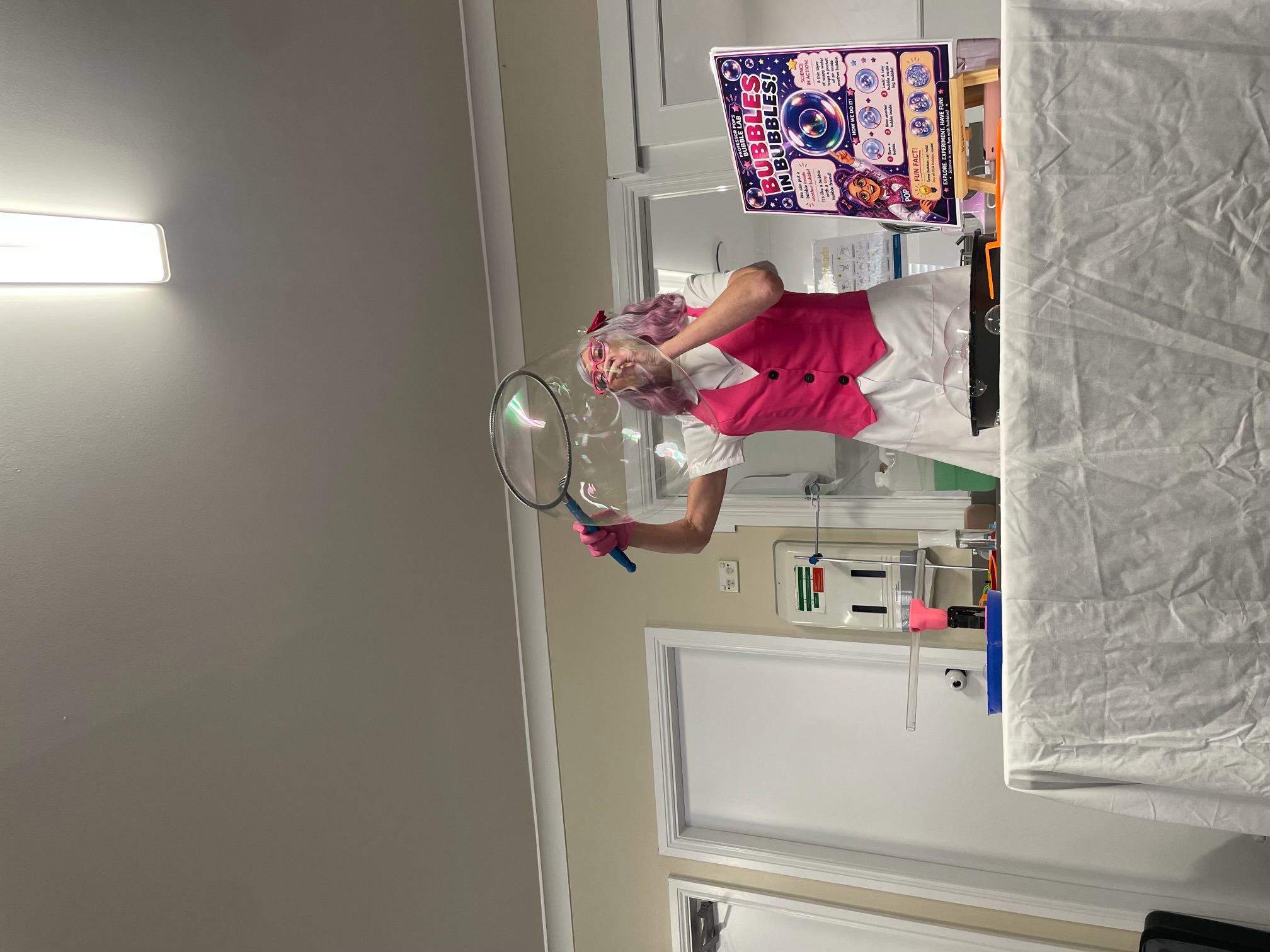
Platypus: Professor Pop’s Bubble Lab
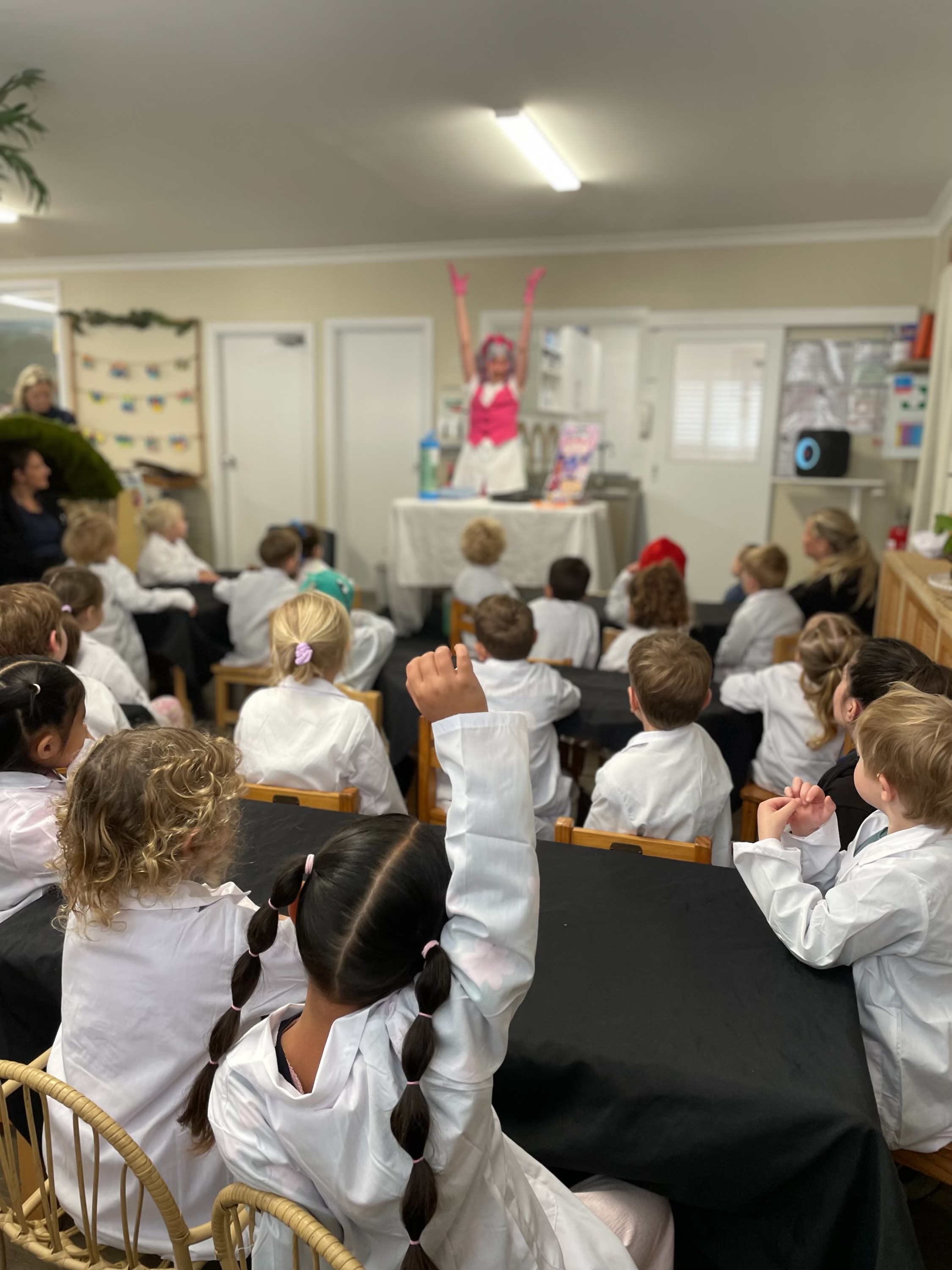
For our Platypus children, the excitement grew as they slipped into their
white laboratory coats and gathered around
Professor Pop’s Bubble Lab.
Something seemed to shift as the coats went on. The children stood a little
taller, watched a little closer and proudly stepped into the role of scientists.
Then the experiments began.
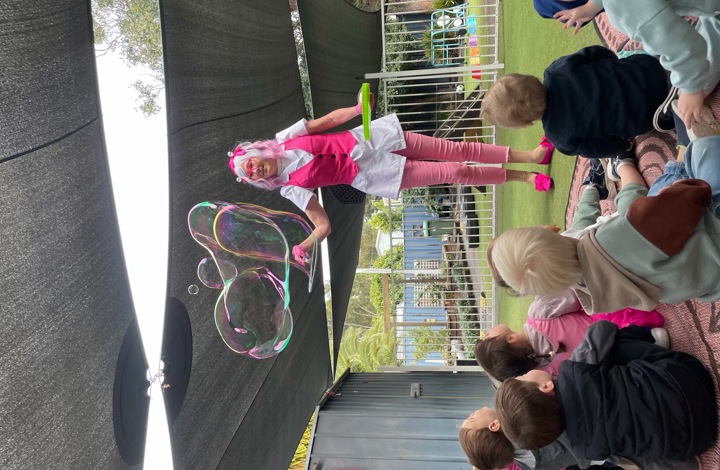
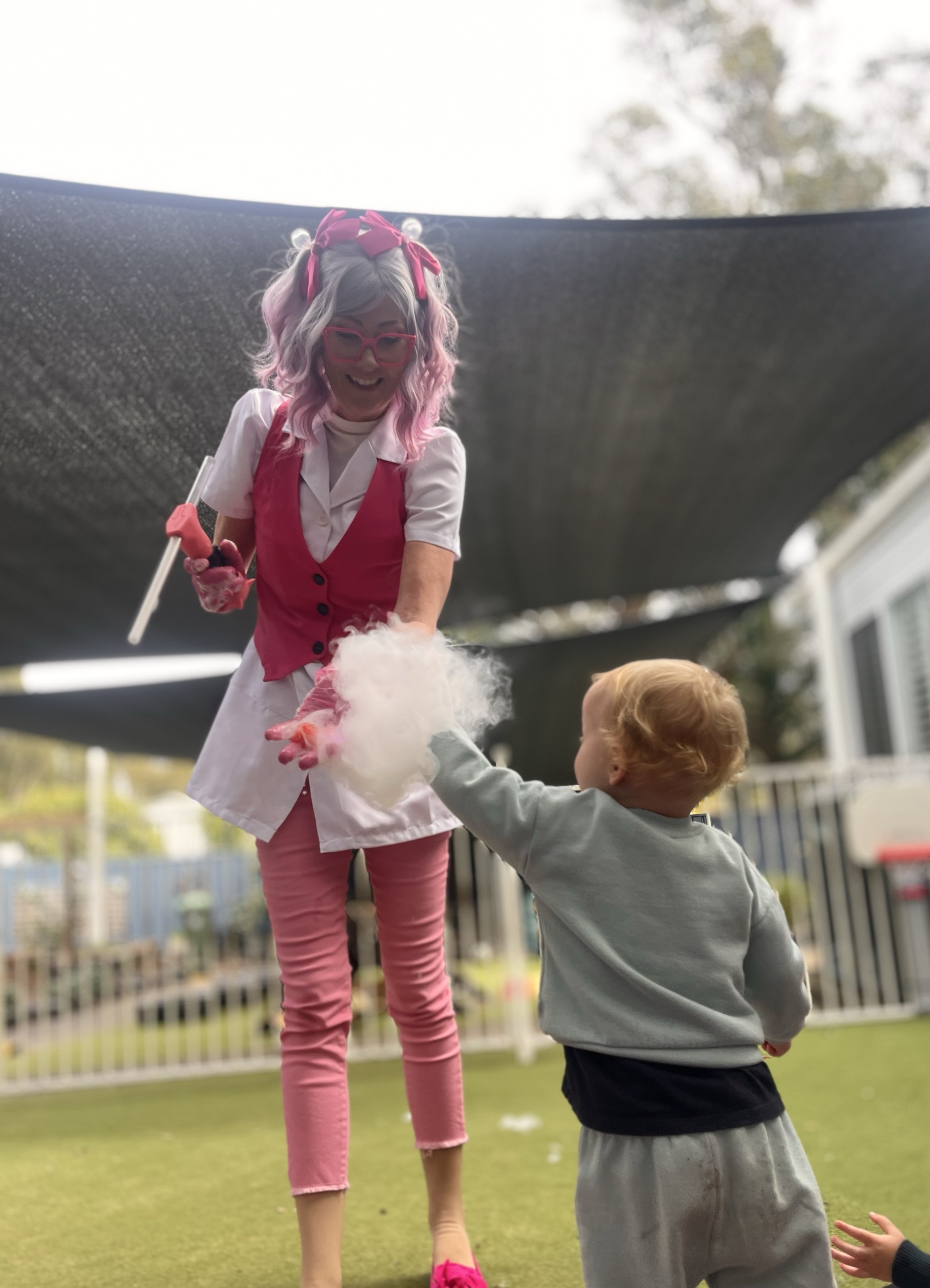
Professor Pop created enormous shimmering bubbles, bubbles that joined and
separated, bubbles that twisted and moved, and bubbles filled with swirling
vapour that looked almost like tiny clouds.
Jonah was immediately drawn to these transformations:
“All the ones with the smoke in the bubble, like the tornado and the kettle.”
His observation captured one of the most fascinating elements of the
experience—the opportunity to see gases and vapour behaving in ways that
are usually invisible.
As bubbles floated through the room, the children began reaching, predicting,
testing and wondering.
Ryder remembered:
“Catching the bubbles.”
Hallie was fascinated by the visual effects of light:
“I liked the big bubble I made on the light.”
Questions naturally began to emerge. How did the bubble become so big?
Why did it float? What was inside it? Why did that one pop? How did the
vapour get inside the bubble?
Each question became a seed of scientific thinking—an opportunity to
observe, develop a theory, test an idea and build new understanding.
Inside a Giant Bubble
Then came the moment everyone had been waiting for.
One by one, the children stepped forward as Professor Pop gently lifted a
giant bubble around them. Friends leaned closer, watching as each child
became surrounded by a translucent wall of colour and light.
“I liked going in the giant bubble.” — Luna V
“I liked going in the big bubble.” — Saya
“Looking at the bubbles and going inside the giant bubble.” — Lua
“Watching people go in the giant bubble at the end.” — Lottee
“Blowing the bubbles out of my giant bubble.” — Theo
When Koda was asked what he enjoyed most, there was no need to choose:
“All of it!”
Seeds of Science
The 2026 National Science Week school theme,
Seeds of Science: Nurturing Knowledge for All, came alive across
both experiences.
Whether children were reaching for their first floating bubbles or
investigating giant bubbles with Professor Pop, they were invited to wonder,
notice, predict, experiment and discover.
Through playful exploration, the children encountered ideas about:
Air and gases: discovering that something we cannot
always see can still fill space and create movement.
Cause and effect: noticing how blowing, touching and
moving changed what happened.
Surface tension and shape: observing how bubble films
stretch and form spheres.
Movement and forces: watching bubbles rise, fall,
float and spin.
Changing states and matter: noticing liquids, gases
and visible vapour.
Light and colour: observing reflections and
rainbow-like colours across bubble surfaces.
Scientific inquiry: asking questions, making
predictions, experimenting and observing results.
Science looked different for each age group, but the foundation remained
the same:
Wonder. Exploration. Discovery.
Most importantly, the children were learning that science belongs to them.
It can begin with a reaching hand, an excited jump, a shared “Look!” or the
simplest and most powerful question:
What will happen if…?
Where to Next?
The seeds planted during Science Week will continue to be nurtured through
our everyday curriculum.
We will revisit the children’s interests through bubble-making, experiments
with different tools and solutions, explorations of air and wind outdoors,
and investigations into what makes bubbles stronger, weaker, larger or smaller.
Children will continue to represent their emerging scientific theories
through drawing, construction, movement, sensory exploration, dramatic play,
conversation and experimentation—recognising the many languages children
use to understand and communicate their world.
On this day, we did not simply watch bubbles float and pop.
We wondered.
We predicted.
We experimented.
We discovered.
At Lakeview Preschool, we believe some of the most meaningful learning happens when children are deeply engaged in play.
Play-based learning gives children the freedom to explore, investigate, create, imagine and make sense of the world around them. While it may look like children are simply playing, there is often a great deal of learning happening beneath the surface.
Play is how young children learn
Through play, children develop important skills across every area of their development. Building with blocks can introduce early mathematical concepts. Creating a pretend café encourages language, cooperation and problem-solving. Exploring outdoors can lead to discoveries about nature, science and the environment.
When children are interested and involved, learning becomes meaningful.
Building confidence and independence
Play gives children opportunities to make choices, test their ideas and work things out for themselves. Sometimes things don't go as planned — a tower falls, a construction doesn't work or a game needs to be negotiated with friends.
These experiences help children develop persistence, resilience and confidence in their own abilities.
Developing social and emotional skills
Playing alongside others provides countless opportunities to practise sharing ideas, listening, negotiating, taking turns and understanding different perspectives.
Children also learn to recognise and express emotions, resolve disagreements and build relationships — skills that are just as important for school and life as early academic knowledge.
Learning through curiosity and discovery
Young children are naturally curious. They wonder, experiment and ask questions about everything around them.
A play-based environment allows those interests to become the starting point for deeper learning. Rather than simply giving children answers, we encourage them to investigate, experiment and discover possibilities for themselves.
The educator's role in play-based learning
Play-based learning doesn't mean educators simply stand back and watch.
Our educators carefully observe children's interests and development, create engaging environments, introduce new ideas and resources, ask thoughtful questions and extend learning as it happens.
Knowing when to step in — and when to give a child the time and space to discover something independently — is an important part of intentional teaching.
What play-based learning looks like at Lakeview
At Lakeview, our environments are designed to invite curiosity, creativity and exploration. Children have opportunities to build, create, investigate, imagine, move, collaborate and spend time outdoors throughout their day.
Experiences grow from children's interests, their relationships and the world around them, allowing learning to develop naturally while our educators intentionally support each child's individual development.
For us, play isn't something separate from learning.
.jpg)