COMMITMENT TO CHILD SAFETY
Safe. Heard.
Respected.
Every child has the right to feel safe, respected, heard and protected.
At Lakeview Preschool, child safety is at the heart of everything we do. It is embedded in our culture, relationships, environments, curriculum and the decisions we make every day.
OUR COMMITMENT
Children's safety
is paramount.
Lakeview Preschool is committed to being a child safe organisation. We have zero tolerance for child abuse, harm, neglect, bullying or harassment and are committed to the safety, participation and empowerment of every child.
Our approach is guided by the National Principles for Child Safe Organisations and the Child Safe Standards. We continually review our practices, policies and environments so children's rights, dignity, wellbeing and participation remain central to every decision.
OUR COMMITMENT IN PRACTICE
What child safety
means at Lakeview.
These commitments guide our culture, our relationships and our everyday practice.
Children's safety is paramount.
Child safety is visible in our leadership, philosophy, policies, curriculum and everyday decision-making.
Children have a voice — and we listen.
Children are encouraged to express their views, contribute to decisions and tell us when something does not feel right.
Families are partners in keeping children safe.
We communicate openly with families and invite feedback about our child safe practices, policies and environments.
Every child has the right to belong.
We are committed to inclusion, equity and cultural safety and respect every child's identity, background, abilities and family.
We recruit people who share our commitment.
Child safety informs our advertising, interviews, reference checks, induction, mentoring and ongoing supervision.
Children and families can speak up.
Concerns and complaints are taken seriously and responded to promptly, respectfully and transparently.
Safeguarding is everyone's responsibility.
Educators undertake ongoing child protection learning and understand their responsibilities for recognising, responding to and reporting concerns.
Our environments are designed with safety in mind.
Physical, emotional and digital risks are continually assessed, with children's own perspectives helping inform our decisions.
We continually review, reflect and improve.
Feedback, incidents, near misses, professional reflection and emerging guidance are used to strengthen our practices.
Our policies are lived in practice.
Child safe policies, procedures and our Code of Conduct guide everyday decisions and are regularly reviewed with our community.
CHILDREN'S VOICE & EMPOWERMENT
Children need to know
their voice matters.
Being child safe means helping children understand their rights and giving them genuine opportunities to participate in decisions that affect them.
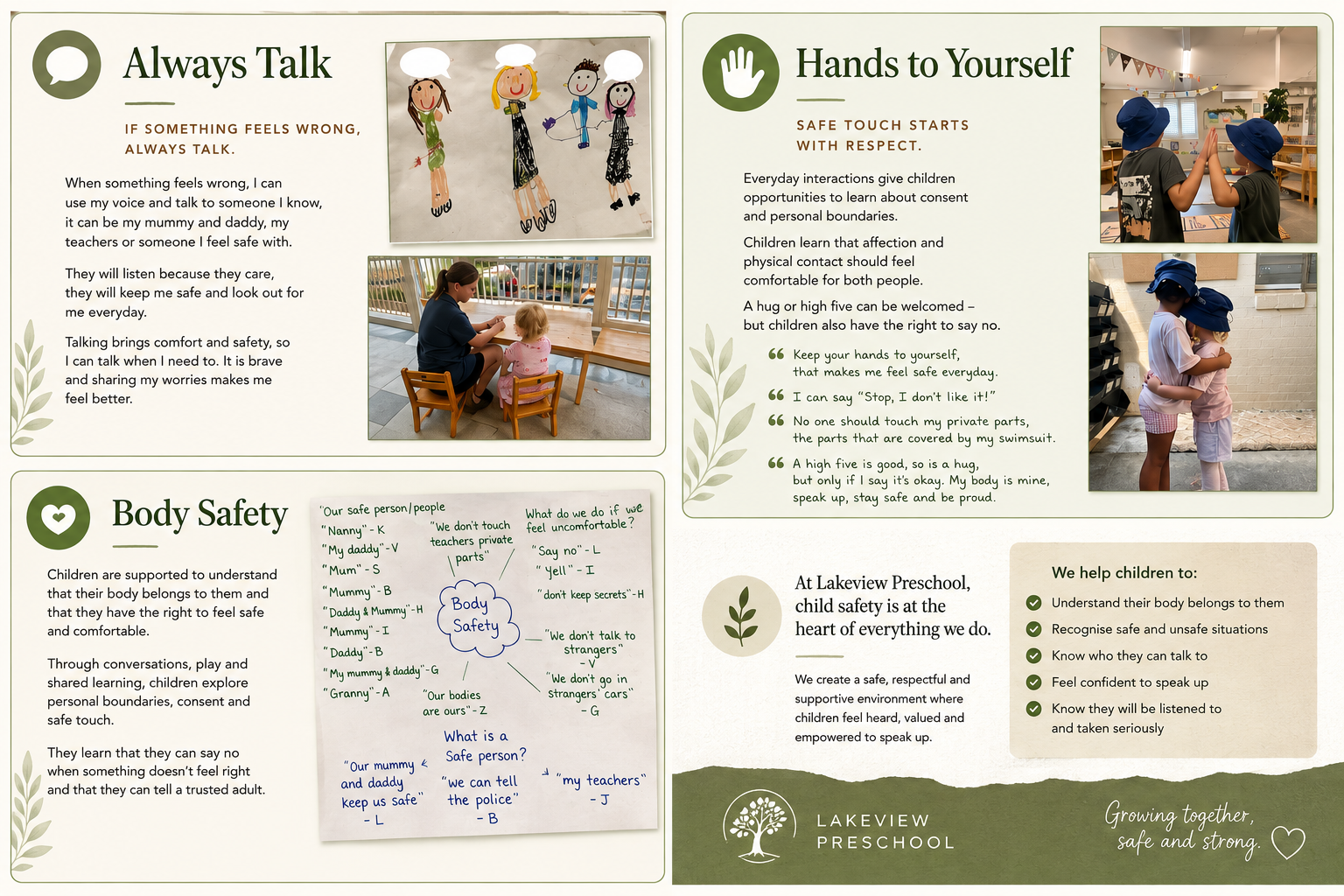
At Lakeview, children contribute through everyday conversations, project work, our Children's Council and our Lakeview Child Safe Book. Their ideas help inform learning experiences, environmental reviews, supervision and risk assessment.
Protective behaviours and body-safety concepts are embedded through age-appropriate learning, helping children recognise safe and unsafe feelings, understand body ownership and identify trusted adults.
SPEAKING UP
Concerns are heard.
Children are taken seriously.
We want every child and family to feel confident speaking up whenever something does not feel right.
Children are supported to identify trusted adults and understand, in age-appropriate ways, that they can tell someone if they feel worried, uncomfortable or unsafe.
Families are encouraged to ask questions, provide feedback and raise concerns at any time. Our complaint and reporting processes are designed to be accessible, respectful and responsive.
Any concern, disclosure, allegation or suspicion relating to a child's safety or wellbeing is taken seriously and responded to in accordance with our policies and reporting obligations.
CULTURAL SAFETY & INCLUSION
Every child deserves
genuine belonging.
Child safety includes physical, emotional, cultural and psychological safety.
We welcome and respect children and families of different cultures, abilities, backgrounds, family structures and circumstances and aim to remove barriers to participation wherever possible.
Aboriginal and Torres Strait Islander perspectives, cultural identity, family knowledge and community relationships inform our environments, curriculum and ongoing reflection.
We continually consider whose voices may be missing and what we can do to ensure every child experiences respect, inclusion and belonging.
OUR PEOPLE
Child safety starts
before employment.
We seek educators who understand that protecting children is an essential part of their professional responsibility.
Child safety is incorporated into recruitment, reference checking, Working with Children Check requirements, interviews and induction.
Our Child Safe Code of Conduct establishes clear expectations for professional boundaries, respectful interactions, supervision, communication and responding to concerns.
Ongoing professional learning, mentoring, reflective supervision and discussion help educators maintain current knowledge and confidently respond to emerging child safety issues.
EVERYDAY SAFEGUARDING
Safety is built into
everyday practice.
Our safeguarding practices extend across supervision, intimate care, toileting, nappy changing, safe sleep, photography, digital devices and the physical design of our environments.
Clear procedures support accountability while protecting children's dignity, privacy, trust and emotional wellbeing.
Children also contribute to environmental and safety discussions, helping educators understand where they feel safe and identifying opportunities to strengthen supervision and learning environments.
PRIVACY & DIGITAL SAFETY
Children's privacy
matters online too.
Safeguarding children extends beyond our physical environment.
We critically review photography, digital platforms, mobile devices, interactive technology and online resources through the lens of children's rights, privacy and digital footprints.
Digital risks are assessed and our practices continue to evolve in response to legislation, professional guidance, family consultation and emerging technology.
ALWAYS LEARNING. ALWAYS IMPROVING.
Child safety is never
considered finished.
We review child safety through children's voices, family feedback, educator reflection, incidents, concerns, near misses, environmental audits, professional learning and emerging research and legislation.
What we learn directly informs our policies, professional development, Quality Improvement Plan, Child Safe Action Plan and leadership decisions.
Our Child Safe Action Plan is a living document, supporting us to monitor progress, identify new risks and continually strengthen our safeguarding culture.
OUR PROMISE
Every child should know
they belong, they matter
and they are safe.
Child safety is everyone's responsibility.
